Note: Every family’s circumstances are different. Time, energy, work commitments and the support a child needs can all shape what is possible on a holiday day. These are simply ideas to take from, adapt or leave behind, according to what works in your home.
School provides our kids with a familiar sequence of events. Even when a child is glad to have a break from it, losing that sequence can feel unsettling.
A day at home may be exactly what they need, but “we’ve got nothing planned” can sound like “I have no idea what will happen next”.
(And, as parents juggling caring, jobs and life admin, we often don’t know what will happen next! Adding to this, some of us are Autistic ourselves and are just as thrown out by the lack of routine.)
The good news is, you don’t need to book an outing for every day.
But giving an ordinary day a shape can help, even if you still need to support your child through parts of it.
Choose parts of the day that can happen in roughly the same order: breakfast, getting dressed, a morning activity, lunch, quiet time and an early evening check-in. These are the bones of the day. What happens between them can change.
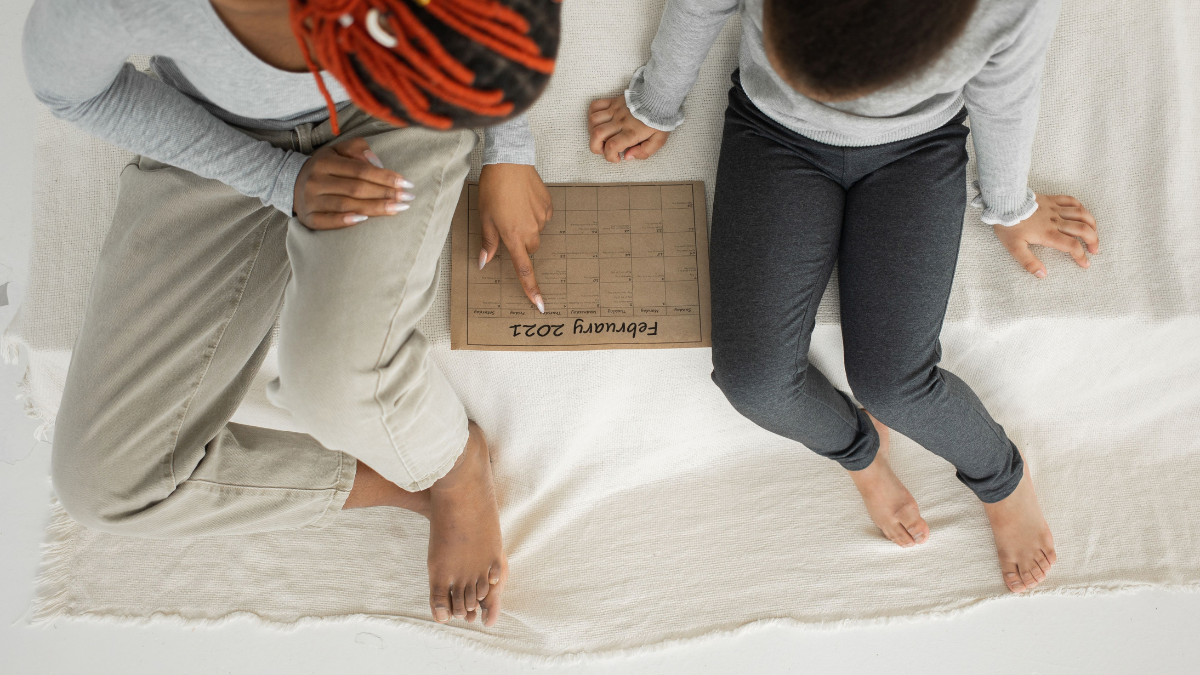
For a child who likes detail, you might write out the day’s plan together over breakfast, which immediately provides you with a predictable activity to start the morning. Another child might prefer just three headings: morning, after lunch, evening. Use pictures, words, a whiteboard or sticky notes, depending on what your child finds easiest to follow.
Include the unremarkable things. “Lunch at home” and “Mum does some work while I build Lego” is still useful information. A schedule doesn’t have to be exciting to be reassuring.
You can also be honest about uncertainty: “I need to make a phone call this morning. After that, we’ll decide what’s next.” A schedule doesn’t have to be exciting, or certain down to the minute, to add structure to the day.
A day with no outing planned can still contain things to anticipate. You might choose one small activity for the morning and one for the afternoon: making brownies, doing a puzzle or taking the dog for a walk and collecting interesting leaves.
These aren’t tasks to keep your child constantly busy. They are reference points. Your child knows something will happen after breakfast, what comes after lunch and when they will have time to themselves.
It can help to offer a small choice: “Would you like to do some drawing or go to the park this morning?” Two realistic options can be easier to navigate than “What do you want to do today?”
And the local library can be a fun, free, nearby outing in itself. They often have Lego tables, beanbags – and peace and quiet! During the holidays, they may also have child-friendly events such as craft activities or talks from children’s book authors. Check out their website to see what’s on.
A project your child can return to each day can give a home-based holiday its own rhythm. They might draw a map of an imaginary world, build a Lego town, make a comic, sort a collection, or research a favourite topic.
Time spent deeply engaged in a favourite interest is a meaningful way to spend a holiday.
Put “project time” in a familiar place in the day, but let your child decide whether and how to return to it. They may need you to help set it up each time, or they may lose interest after two days. That’s okay. There is no deadline or required finished product. The idea is simply to have something familiar available when it appeals.
“Go and play” can ask a lot of a child who is tired or unsure where to begin. Try making one or two activities visible and ready to use. Put craft supplies on the table, leave out a favourite book series or set up a tray with sensory materials. These do not need to be professional or expensive. Some of our favourite replacements are Blu-Tack for clay and water-filled latex-glove puppets with faces drawn on them for a novel toy. Water play at our house involves filling up water balloons, tying them off, running a bath and letting the kids play with the bobbing balls in the bath.
They might follow a guided drawing online video of a favourite animal or character, then turn their picture into a sign for their bedroom door. You could download an audiobook for your child to listen to while colouring. If your child needs company to begin, try doing the first few minutes together. You might help gather materials, start a drawing beside them or read the opening page of a book. They may then want to continue alone, or they may need you to stay. Starting together is an option, rather than a promise that they will soon be occupied independently!
Body doubling means doing your own activity alongside someone else. Having another person nearby can sometimes make it easier to get started or stay engaged, even when you are working on different things.
You might do the dishes while your child builds on the floor beside you, or answer emails at the table while they draw. On a good day, this might give them the company they want while you get something done. On another day, they may still need your attention every few minutes. (Body doubling is worth trying if it suits your child, but it doesn’t magically turn parenting time into uninterrupted work time.)
School can take a great deal of energy. Some children need holidays to be quieter than adults expect.
Rest doesn’t have to be earned after an activity, and a day doesn’t need to produce anything.
You can make downtime more predictable by naming it: “After lunch is quiet time. We can read, play a game or spend time in our own spaces.” Some children will welcome time alone. Others may need you close by to settle, or may not experience a request to “go and rest” as restful at all. Find out what helps your child recharge, and remember that parents need pauses too.
If your child enjoys screens, screen time can have a clear place in the day. Knowing when it is available may be more helpful than repeatedly negotiating it.
There is no need to treat every moment on a device as a failure of the holiday plan.
A holiday routine works best when it has room for real life. You might say, “This is our plan for today. If it’s raining, we’ll have our picnic inside.” If an activity depends on the weather, another person or your own energy, show the alternative from the start.
Try to give notice before transitions, especially when your child is absorbed in something they love. “We’ll have lunch after this episode” may be more useful than suddenly announcing that it is time to stop. Even with notice, a change may still be hard. Your child’s difficulty moving on doesn’t mean the plan was pointless. It tells you they need support at that moment.
Ask what makes a day feel good to them. Do they like knowing the exact time of an activity, or just its place in the sequence? Do they want an outing to look forward to each week? Would they rather repeat a favourite activity than try something new?
Some Autistic children love a detailed timetable; others experience one as a list of demands. Some will help make a plan but struggle to follow it once the day begins. The aim is to offer predictability with room for choice, while being realistic about what your family has the time and energy to do.
A holiday day might include breakfast at the usual time, a favourite show, a project you start together, lunch and a quiet afternoon at home. It might also include interruptions, changed plans and a parent who gets much less done than they hoped.



The Reframing Autism team would like to acknowledge the Traditional Owners of the lands on which we have the privilege to learn, work, and grow. Whilst we gather on many different parts of this Country, the RA team walk on the land of the Awabakal, Bidjigal, Birpai, Darumbal, Gadigal, Kaurna, Peramangk, Whadjuk, Wiradjuri and Wurundjeri Woi-wurrung peoples.
We are committed to honouring the rich culture of the Aboriginal and Torres Strait Islander peoples of this Country, and the diversity and learning opportunities with which they provide us. We extend our gratitude and respect to all Aboriginal and Torres Strait Islander peoples, and to all Elders past and present, for their wisdom, their resilience, and for helping this Country to heal.


 Donate