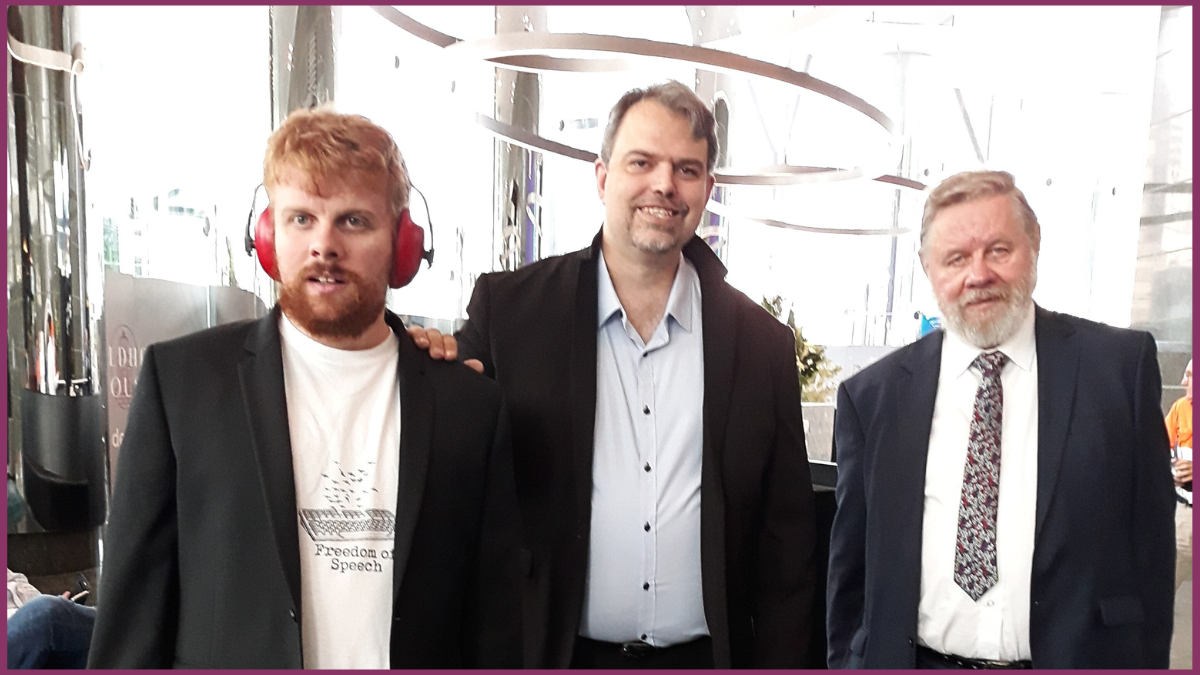
Ben with some of his supporters
Written by Ben Kingston
It is pleasing to hear that individuals are choosing to empower themselves with their own choice of communication strategies that work for them, rather than be dictated to by professionals, academics or government funding bodies.
Looking to the future, I hope that this control from individual choice will continue to move forward for us, as it is no longer sufficient that control is taken away and vital decisions are made for us without consulting us.
On the subject of control, it’s problematic to assume from the perspective of the individuals without speech that they are in full control when they are so highly dependent on others for their day-to-day needs.
I’m very dependent on my Mum for my survival needs but I’m also dependent on her for my communication needs to make daily requests and for her to give me the opportunity to communicate the things I’m needing to say.
This opportunity to communicate is just as important as the communication systems themselves, as I would not be able to communicate my thoughts if Mum and others in my life did not believe that I had something to say.
I’m so fortunate that I’ve been given these opportunities to communicate from an early age, as this is sadly not common for many individuals without speech.
So how do we provide these opportunities?
This requires a paradigm shift for professionals and families to have access to resources and advocates who can demonstrate that, with the appropriate communication systems, non-speaking individuals can thrive in the right supportive environments.
Opportunities cannot happen without support and support cannot genuinely happen without the right mindset, which is where problems start arising – like old and outdated beliefs about non speaking individuals.
In order to accommodate the new paradigms we must take into account the lived experience of non speaking individuals.
Family members can also provide valuable information for research. I’m hoping to make some difference in the lives of non-speaking individuals by writing from my own lived experience to educate and inform the community about Augmentative and Alternative Communication (AAC). I’m very passionate about this, because I’m sure that there are many individuals who are being denied the right to communicate by either uninformed families or by professionals who are not well equipped or have preconceived notions about the competency of non-speaking individuals.
Such attitudes create a self-fulfilling prophecy that limits individuals for the rest of their lives. This is a tragedy and a violation of human rights and the right to communicate one’s thoughts and feelings.
This has to be stopped but it will take an enormous grass roots action to talk to government bodies which are making decisions about disability policy.
I’m convinced that we can’t just sit around and expect the government to do things for us. We must drive this new movement ourselves, by going directly to the government representatives to tell them our stories and lived experiences.
They need to know that – with the necessary support to access AAC strategies – non-speaking individuals can show ourselves capable of working and contributing to society, rather than being trapped in our bodies and stuck in our homes, isolated from our communities.
It’s more important for a non-speaker to have several different strategies displays and devices so they can use the most effective strategy for a particular situation and not be dependent on only one device or strategy that may not always be appropriate for the situation, so a toolkit of different strategies is essential.
“My name is Ben Kingston and I am a non-speaking Autistic man with a lot to say. I’m passionate about advocating for the right to communicate for people with complex communication needs.”


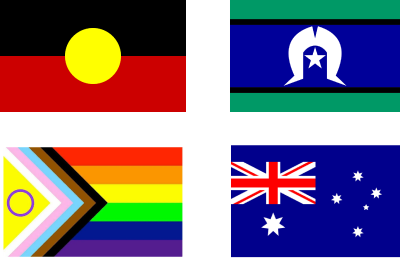
The Reframing Autism team would like to acknowledge the Traditional Owners of the lands on which we have the privilege to learn, work, and grow. Whilst we gather on many different parts of this Country, the RA team walk on the land of the Awabakal, Birpai, Whadjak, and Wiradjuri peoples.
We are committed to honouring the rich culture of the Aboriginal and Torres Strait Islander peoples of this Country, and the diversity and learning opportunities with which they provide us. We extend our gratitude and respect to all Aboriginal and Torres Strait Islander peoples, and to all Elders past and present, for their wisdom, their resilience, and for helping this Country to heal.


 Donate